Translate

Sunday, June 25, 2017

Welcome to Monsters Part 6: The Monsters in My Head

I was originally going to end this blog post with the Monsters Next Door post, but there's one more type of monster that I feel I should address. Those are the ones my mind creates.

There's no doubt that I have an overactive imagination. I was one of those kids who could make up a fantastical story on the spot (but I couldn't lie to save my life). I definitely remember being absolutely terrified by a giant spider in my basement as a kid that would only be able to get me if all the lights were off.

Now that I'm older the monsters my mind conjures up have changed with me. I still get plenty of nightmares where a monster is chasing/hunting me (usually featuring a talking velociraptor). I'll wake up in a panic and it'll take me several minutes to realize that I'm perfectly safe and can go back to sleep. 

There are also the nights were I wake up for no real reason and feel like I'm being watched or there is someone in my room with me. Since I haven't shared a room with anyone since college, it's a freaky feeling. Suddenly every shadow contains a vampire waiting to suck my blood or a ghoul ready to feast on my flesh. 

Lately I've been waking up with the mental image of what I can only describe as a combination of a plague doctor, a Hayao Miyazaki creation, and a tengu (click here for the wiki page on tengu) watching me from across the room. Some day I'll have to create a story or mythos featuring this creature. But just because it looks terrifyingly cool, doesn't mean I enjoy confronting this image in my post-nightmare haze.

An example of a Tengu
These imaginary creatures are great inspiration for my horror stories. I want to know what they are and what they do. Why they might torment someone. Are they a corrupted spirit or an offended god? Will it drink my blood or does it feed off my fear? How do you kill it?

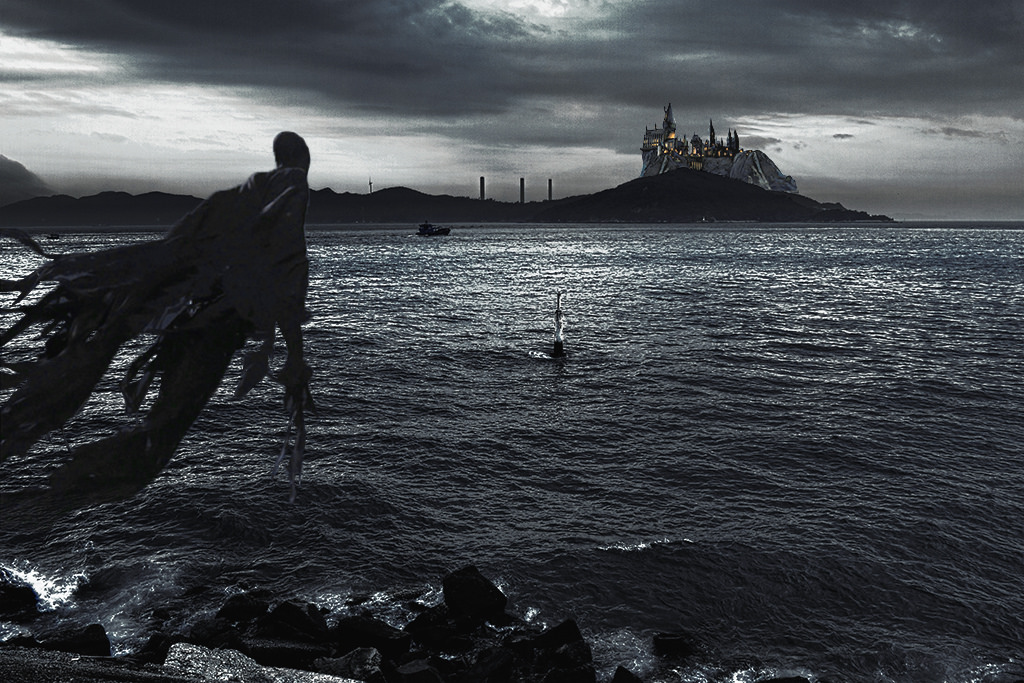
Famous monsters that appear is video games, movies, and books are often used to symbolize a character's (or even the creator/director/author's) inner turmoil. Pyramid Head from Silent Hill 2 is said to follow the player around because they are the manifestation of main character's (James Sunderland) desire to be punished for what happened to his wife. Another example would be the dementors from Harry Potter. J.K. Rowling said that the inspiration for the dementors were a manifestation of her depression. Seems appropriate since they suck out all the happiness from a person, leaving them cold and empty.

Fan fiction writers everywhere, write me a story based on this image!
For some people, depression and anxiety are like monsters. The constant feelings associated with these mental illnesses can feel like a person is battling a monster. And like most monsters I have mentioned in this series, they can be very difficult to defeat. (However, please do not tell someone suffering from a mental illness that it's just in their heads and that all they need to do to be happy is to "feel less sad".)

We all have our personal monsters to face, but that doesn't mean we have to face them alone. Unlike the ancient heroes of old, we shouldn't be afraid to ask for help when confronted with a monster. I know I feel better if I have someone with me helping me overcome my fears and challenges.

Monsters take many forms in our culture. They can represent what we fear most or be used to symbolize our emotional health. Some monsters aren't meant to cause harm, but to teach people to look past someone's physical appearance. Other times monsters are able to seamlessly hide themselves in our society and are only identifiable by how their actions.

I don't think the monster archetype will leave our culture anytime soon. Instead it will keep changing to match what our biggest fears are and reflect which challenges we still need to overcome.

I hope you have all enjoyed my series on monsters. I have certainly enjoyed researching and writing it. I might visit this topic again at some point (I do write a lot of horror right now after all). If you feel there's something I've missed in this series, please let me know.

If you enjoyed this post (or it really pissed you off), please like, share, and/or leave a comment. I love hearing from my readers and I hope you guys like hearing from me. Until next week.

Sunday, June 18, 2017

Welcome to Monsters Part 5: The Monsters Next Door

Some monsters are terrifying because they seem perfectly normal when you first meet them. They may be charming and extremely kind to draw people in, but it's all an act. They're manipulative and play mind games with their victims.

They are a lot like Gaston from Beauty and the Beast.

I keep using this picture.
Right after the live action Beauty and the Beast movie came out, there were the usual million and ten posts about how the movie is romanticizing Stockholm Syndrome and how Belle wants adventure, but then settles for a man. Seeing all these posts over-analyzing a Disney movie gets annoying. But then I spotted an article about how scary Gaston is as a villain.

I wish I had saved the article or (more likely) tumblr post that I had seen explaining why Gaston was so terrifying as a villain. But since I didn't (and I'm too lazy to track it down), I'll just have to summarize the conclusion the best I can.

Basically, the author of the post concluded that Gaston is that bully you know in school whom everyone loves, but terrorizes anyone that crosses them for even the slightest reason. This type of bully is even able to turn an entire community (school or village) against their victim. Remember the Mob Song? In the live action version of the movie, they updated the lyrics to include Gaston bragging about how he is able to manipulate the villagers into doing whatever he wants.

"You can bet they all will follow
For in times like this, they'll do just as I say"

I know I'm not the first person to notice this, but one of the biggest reasons Gaston is such a good villain is because how easily he could have been the good guy in the movie. He's described as handsome, heroic, and beloved by the entire village. Beloved by everyone except for Belle and since Belle refuses to worship the ground Gaston walks on (and she reads) people thinks she's weird. 

In Beauty and the Beast, it's easy to identify Gaston as the villain since we're seeing the story from Belle's perspective. Her disdain for his arrogance and ego make it easy to identify him as an antagonist early in the story. From the begining of the movie, we aren't supposed to like Gaston.

Recently, Disney has been shaking up their villain narratives by having more and more "surprise villains". These villains are much harder to identify early in the story. They usually start out as a supporting character, helpful even, but are really just using the protagonist to achieve their goals. Both Frozen and Zootopia have villains that show up in the third act that are supposed to be a "twist". 

Hans may be a pretty weak villain and almost comes out of no where as a bad guy (I still love the movie, so no real hate here), but his betrayal is very real and catches Anna completely off guard. Anna's hurt is real and she nearly dies because of Hans's cruel actions. And while Zootopia is about overcoming prejudice in society, Bellwether is the "surprise" villain exploiting the problem while trying to take over the city's government and subjugating the predators in the city. 

Hans and Bellwether may not appear scary of monstrous, but their actions certainly are. They have malicious goals and are willing to do anything to achieve them, even kill. 

Then there are the characters who are beloved by those around them while at the same time, just seem to destroy the lives of everyone they come across. The Picture of Dorian Gray centers around a man who sold his soul so that he could maintain his beauty. What makes this story really interesting his how he affects the people around him. Nearly everyone who comes across Dorian Gray suffers a horrible fate. The actress Sibyl Vane commits suicide once she realizes that Dorian no longer loves her. Dorian gets his young friend Adrian Singleton addicted to opium. Alan Campbell is blackmailed by Dorian. Basil Hallward, who painted the portrait (and may have been in love with Dorian) is murdered by Dorian in a fit of rage.

All the while Dorian Gray looks like a respectable member of high society.

If it weren't for ugliness of his portrait to show his true nature, Dorian Gray would have been seen as that dashing bachelor that anyone would have been lucky to associate themselves with. He is the insidious monster that doesn't want to take over the world, but destroys those around him slowly, methodically.

Nearly everyone knows someone who is like Gaston, Hans, Bellwether, or Gray. The people who seem perfectly normal or are even hailed as pillars of their community, but are really egocentric maniacs who will destroy anyone who gets in their way. They are the monsters who are so difficult to realize they are monsters that we don't realize we've been tricked until we are facing our own destruction.

Personally, I think these are the  most dangerous monsters. They will draw you in with a smile and make you think you deserve the knife they stab you in the back with. What's even more terrifying is these types of monsters really exist and can be really hard to identify.

They are the monsters you don't know are monsters until it's too late.

If you enjoyed this post (or it really pissed you off) please like, share, and/or leave a message. I love hearing from my readers and I hope you guys like hearing from me.

Until next week.

Sunday, June 11, 2017

Welcome to Monsters Part 4: The Monster in the Machine

Before I begin today's blog, I have an announcement. A few weeks ago, I worked up the courage to submit a short story I had written to a literary magazine. Today I got my first rejection email. Yeah, I know it's not good news. However, it did get me over my fears of rejection. I'm going to keep trying until I get that sweet acceptance. Even if that means getting hundreds of rejections.

I am a glutton for punishment after all...

Monsters are very often associated with the unknown and what is more unknown in today's society than where technology will take us next. There are dozens to hundreds of movies, books, and video games out there where robots or AIs have had enough of human's shenanigans and decides we must be terminated.

There's even a movie called Terminator which has this very basic plot point.

Which one is out to get us Mr. Smith?

When ever AI (artificial intelligence) or robots are brought up in the media, there's always this underlying worry that one day they'll go on a murderous rampage against humanity. It's not a new fear. Frankenstein's monster could easily fall into this category if he were made of metal instead of flesh.

Now, do I believe that humans will be eradicated by machines?

No, not at all. I highly doubt the apocalypse will happen because of angry robots or an AI system gone rouge. Sure, they might replace us in the workforce, but it's highly unlikely they will suddenly get minds of their own and wipe out humanity. Someone or a group of someones will hack the machines first.

If you think about it, the Three Laws of Robotics has humans covered. That is, if we're certain these three laws are totally applicable. I believe they are and, without some human element, unlikely to fail. If you're unfamiliar with Asimov's Three Laws, they are listed below:

1) A robot may not injure a human being or, through inaction, allow a human being to come to harm.
2) A robot must obey the orders given it by human beings except where such orders would conflict with the First Law.
3) A robot must protect its own existence as long as such protection does not conflict with the First or Second Laws.

Technology, for the most part, is a tool that helps human kind. Like all tools, accidents can happen. I'm far more worried about a driverless car glitching and causing an accident than I am about a robot realizing that I am obsolete. If the robot apocalypse does happen, it will be because some stupid/ and/or vengeful human programmed it to.

That doesn't mean there are other monsters in the machine to worry about.

Technology is changing daily and it really is only a matter of time before we begin to merge with our tools. Cyborgs already exist (no not the DC character - though that would be totally awesome and I can't wait for the movie). I'm talking about people (or really any organic being) who have biomechatronic body parts. How common will a mechanical arm be in the future? What about implants that allow us to access the Internet with our eyes?

My biggest fear is what hackers will be able to do with all this technology.

When Stephen King wrote the novel Christine, do you think he was envisioning a world where driverless cars would someday be the norm? Probably not since Christine was a possessed car. But think about it. How likely is it that a hacker might be able to kill someone with a car that drives itself? What about killer drones?

Then there's what happens in Ghost in the Shell. For the record, I'm only familiar with the 1995 anime movie and one of the creepiest parts that I remember from this movie is about a guy believing he had a wife and daughter. Except he didn't. In fact didn't have any family whatsoever. You see, the people in Ghost in the Shell had merge themselves with technology. Very few people are 100% organic in this world. The villain of the story had "ghost-hacked" this person and fabricated memories. No matter how much evidence was shown to him, he truly believed his wive and daughter were waiting for him at home.

Ghost in the Shell (at least the 1995 version) raises a lot of questions about how technology and humans will interact in the future. There are a lot of questions about identity, reproduction, and what it means to be alive. There's a sense that, at some point, humans might not be able to disconnect themselves from the technology they so heavily rely on.

Which is why I don't think robots are the monsters. It's what people do with the technology that I'm worried about.

So, why are there so many stories featuring rouge AIs and robots as monsters? I think it comes back to the age old question of why are humans here? Why do we think? Why are we so curious, creative, and destructive? The philosopher René Descartes once said "cogito ergo sum" or "I think, therefore I am" as proof of one's own existence. We can only prove our own existence (and by extension other humans) because we know we can think. What we don't know is what else can think or, at least, has some form of self awareness? How will we be able to tell if a machine has gained some form of self awareness?

Answer: we can't. And that's what makes technology such a threat.

So don't be scared of technology. Be afraid of who programmed it. Be afraid of who can hack it. Because humans are the ones behind it all.

If you enjoyed this post (or it really pissed you off), please like, share, and/or leave a comment. I love hearing from my readers and I hope you guys like hearing from me. I have a least two more blog posts planned for this particular series. So I hope you are enjoying my take on monsters.

Until next week!

Sunday, June 4, 2017

Welcome to Monsters Part 3: The Monsters That Just Need a Hug

Who didn't have that one friend who absolutely loved Remus Lupin in the Harry Potter series? Or maybe I really was the only person surrounded by his fan girls.

I swear that this picture is relevant...
Regardless, Remus Lupin made Harry Potter fans everywhere sympathetic to werewolves in a time when werewolves were still seen as evil creatures that needed to be destroyed (basically before there was a Teen Paranormal Romance section at Barnes and Nobles). He is probably one of the first examples J.K. Rowling gave us of someone who chooses to be "good" despite what society defines them as.

The fact that J.K. Rowling created characters who made choices and weren't evil because of who they were born as is a major theme of the Harry Potter series. This message is made extremely clear in book 4 (Goblet of Fire) when Dumbledore says to the Minister for Magic, Cornelius Fudge "it matters not what someone is born, but what they grow to be." This stands in sharp contrast to a lot of fantasy troupes that were seen all over the place in popular culture before these books. The best (and most well known) example of evil by virtue of birth are the Orcs from The Lord of the Rings trilogy.

The scene where we discover that Lupin is a werewolf (at least in the books) shows the extreme prejudice he faces every day. Harry is noticeably the only member of the Golden Trio to not react badly at the declaration that Lupin is a werewolf. Both Ron and Hermione show open distrust and hostility once the secret is revealed. They quickly change their minds about Lupin, but their initial reaction still stands as pretty normal when a wizard meets a werewolf. The only reason Remus Lupin might be considered a monster is because he turns into a werewolf once a month.

Remus Lupin isn't the first example of a sympathetic "monster". There's also the Beast from Beauty and the Beast, David in An American Werewolf in London, and an argument can even be made for Tony Stark from the Marvel Cinematic Universe. Each is put in a position where they are seen as a villain or monster to someone else, but are just trying to make the best of a bad situation.

The character David from An American Werewolf in London (much like his predecessor Larry Talbot from the 1941 The Wolf Man) is bitten by a werewolf. However, unlike the situation Remus Lupin found himself in, David has zero resources to help him during his transformations. He spends a good chunk of the second part of the film seeing hallucinations of the people he has violently killed while a werewolf. The hallucinations tell him what an awful person he is and that he should kill himself before he can kill anyone else.

(Next paragraph contains spoilers for An American Werewolf in London. This is your only warning!)

By the end of An American Werewolf in London, I sincerely wanted David to have a happy ending. I really did. Though, his mental health had significantly deteriorated and he knows he is responsible for the murders he commuted while transformed, it is still very clear that he wanted to live. But (spoilers) monsters don't get happy endings in these types of stories. Much like Larry Talbot before him, David is cornered in his werewolf form and shot to death. What is most tragic is that David seems almost relieved to die.

I may or may not have cried...a lot.

Werewolves seem to have a much more sympathetic representation in our popular culture than say vampires or zombies. Maybe it's because it's easy to identify with the werewolf condition. J.K. Rowling has been quoted as saying she used Lupin's condition as "a metaphor for those illnesses that carry a stigma, like HIV and AIDS." And unlike the vampire and zombie condition, which is constant, werewolves typically look and act like normal people until their affliction takes control.

That's not to say that vampires or zombies can't be sympathetic. The scene in Shawn of the Dead where Shawn has to kill his mother, is incredibly sad. Thankfully that movie has a somewhat happy, and pretty ridiculous, ending. But it does drive home the fact that the zombies were once humans who were loved.

Then there are monsters like The Beast from Beauty and the Beast. As a human, The Beast (or Prince Adam as dubbed by his adoring fans) had a personality that was severely lacking in empathy and charity. This leads to his curse and monstrous form.

I know that if I were in Belle's shoes, I would have screamed bloody murder. The Beast looks terrifying, especially since we first see him in the shadows of a dungeon. Though Belle reacts to his terrifying looks by shirking away from him with a gasp, she is able to look past his appearance (and he stops being a jerk to her) to fall in love with him. However, when Belle shows the image of The Beast to the villagers, they immediately form a mob and go off to "kill The Beast!"

This sequence of events leads to one of my favorite lines in the Disney version of Beauty and the Beast: "we don't like what we don't understand, in fact it scares us, and this monster is mysterious at least." Society judges The Beast to be a monster simply by how he looks. The Beast is tired and thinks he is doomed to spend the rest of his existence as a monster. At this point, he doesn't care if Gaston and the villagers are going to kill him or not. It isn't until Belle reappears that The Beast is able to find the will to live.

The villagers panic over the fact that The Beast looks scary even though he has never actually done anything to them. They have zero reasons to try and kill him.

There's actually a real life example of people hiding away from society due to a scary appearance. Raymond Robinson (1910 - 1985), also known as the Green Man, became horribly deformed in a childhood accident. To prevent people from panicking when they saw him, he would only go out at night and stay away from the main parts of his hometown. He eventually became a local legend known as the Green Man. Some people in his local community were shocked to discover that he really did exist and had an unfortunate even in his life take place.

But what about the monsters who don't look like monsters? Or, more specifically, what about the people who do terrible things because they think they have to?

I mentioned Tony Stark from the Marvel Cinematic Universe (I'm not as familiar with his other media) earlier in this post and some of you might be wondering why. To be honest, Tony's ego is his biggest weakness and is what qualifies him to being a monster. It's because of Tony that Ultron destroyed the capital city of Sokovia. If Ultron hadn't had done that, we wouldn't have had half the plot of Civil War.

Speaking of Captain America: Civil War, I backed Captain America during that whole movie. What Tony was asking them to do was to essentially give up their freedom, especially Wanda. Yes, I understood his point about someone keeping the heroes in check and making sure someone was held responsible for when innocent lives are lost (a topic for another time), but Steve Rogers made some really good points too. It also didn't help that Tony locked up half the Avengers after they rebelled against the agreement in the movie.

Tony has some good arguments and tries to do the right thing, but his actions tend to be way too extreme and hurt the people he is closes to. He is the type of monster people don't realize is a monster until they are in his crosshairs. Locking up Wanda instead of trying to help her was a really bad thing to do and stands in sharp contrast to Steve seeing the best in everyone. By the end of the movie, I did feel bad for Tony. He wasn't necessarily wrong with his arguments, but his actions were and he could very easily end up alone because of that.

At the end of Civil War, I saw someone who was devastated by their own actions, even though they still thought they were doing the right thing. I wasn't sure if I wanted to smack him or hug him. Hopefully James Rhodes will be able to get Tony to see where he went wrong.

So not all monsters are the Orcs of Middle Earth. Some have been cast out of society due to things that are entirely out of their control. Others wanted to do the right thing, but instead hurt those they care about most. These characters are important because not everything in life can be put into a "good" or "evil" box.

Life is complicated and tough to figure out. Sometimes it's the monster that needs saving.

If you enjoyed this post (or it really pissed you off) please like, share, and/or leave a comment. I love hearing from my readers and I hope you guys like hearing from me.

Until next week.

Sunday, May 21, 2017

Welcome to Monster Part 2: They Can Be Cute Too

I remember seeing Monsters Inc in theaters. I loved it, especially since I was definitely one of those kids who thought there was a monster in their closet or under the bed, which made the movie seem all the more plausible at the time. It also may have helped me get over this particular irrational fear. I mean, as long as Sully or Mike Wazowski was the monster coming to scar me.

Isn't this just the face of an angle?

Occasionally, monsters go through a child friendly retelling. Most of these stories, if I remember correctly, revolved around the cliche "don't judge a book by it's cover" narrative. It's a good story for kids to learn and understand, especially since monsters are often thought of as monsters because of what they look like.

Then again, Sully from Monsters Inc looked like an adorable cross between a teddy bear and furry alligator. He doesn't look that scary in the movie. But I bet if I ran across a real life combination of these two creatures I'd scream my freaking head off and run for the hills.

 Ah Real Monsters was a similar show from the 90s. It featured three young monsters learning how to be scary. It was a more gross version of Monsters Inc (I think they lived in a dumpster). On a day to day basis the monsters in the show were friendly and just trying to pass their classes. It was when they came across a human, that they would scare them. It was a fun, goofy show for young me to watch (and the monster designs were amazing).

Kids do need to learn that they shouldn't judge a person by their appearance alone. One of my favorite stories as a kid was The House that Drac Built. It was supposed to be a spooky house that was filled with ferocious and scary monsters.

I loved this story and made my parents read it to me all the time (along with Mickey Mouse in The Phantom Blot). The first part of the book included a great build up of how scary and angry the monsters trapped in the house were. The second part of the book had the kids showing up. At first it seemed like the kids would be terrified and run away, but when the kids saw that the monsters needed help or love, they instead spent time with them.

I remember a lot of these stories from the late 90s and early 2000s. Though I might have blocked some of them out of my memory. One day while I was meandering through the nostalgic side of YouTube I stumbled across the opening for a show called Seven Little Monsters. I don't recall actually watching this show (I was a little too old for it), but I do remember seeing it occasionally pop up on PBS while my younger sibling was waiting for a different show (or while I was babysitting).

Seven Little Monsters was about a family of monsters growing up in the human world (or at least that's what I remember). Each monster had their own quirk, which made them different from their siblings. It was a cute show and heavily featured several lessons about using the talents you've been given and not to judge people who look different from you.

In this case, monsters weren't supposed to be scary. They were nice and sweet or held day jobs. It was a way to teach kids to accept those who are different from them. Monsters are convenient to use in these stories, since most kids are already scared of monsters.

What better way to help someone conquer their fears than by making that fear seem more relatable?

Monsters will always be a part of our popular culture. They represent the unknown and inhuman parts of our lives. Monsters can be blood sucking forces of evil and they can be the cuddly 9 to 5 business man who just wants to keep his city supplied with power.

Personally I like both kinds of monsters. Much like people, you never know which monsters are good and which are evil. It's their actions that determine that.

If you enjoyed this post (or it really pissed you off) please like, share, and/or leave a comment. I love hearing from my readers and I hope you guys like hearing from me. Until next week.
Sunday, May 14, 2017

Welcome to Monsters Part 1: Evil Predators Under the Bed

So I wanted to get a few things out of the way before really diving into this week's post. First, everything that I am writing is my opinion which is based on my own experiences and (occasional) research. How I interpret something could be entirely different from how someone else does. Second, I am aware that there are people out there who have done a much better analysis than I am about to do on this topic. That's not going to stop me. Third, I enjoy writing and (to a lesser extent) reading horror. This series has been buzzing in my brain for a while and I'm not entirely sure how long it will go for. You've been warned.

An image from my sketch book... 
The monsters of my childhood were simple. They hid in the darkest shadows of my bedroom, waiting for me to peak out from under the safety of my covers and spirit me away. Only my army of stuffed animals kept the evil creatures at bay.

Or at least that was what my childish logic told me.

They are the predators and we are the prey.

Humans have it pretty good right now from an evolutionary stand point. We've somehow managed to populate every continent on Earth and it's only a matter of time before we start looking at colonizing the moon or building underwater dwellings deep on the ocean floor. There isn't anything on our planet that uses us as a primary food source (bacteria don't count). We are the dominate species.

But we weren't always the top dog and I think a part of our instinct subconscious remembers that.

Many of the scariest and most evil of monsters in our classic and popular culture (at least the western  culture which I am most familiar with) are terrifying because they prey on humans or want to cause serious harm. Manticores are known for consuming their victims whole, leaving no shred of evidence behind. Vampires want to suck the life right out of you. Zombies will tear out your throat and start eating you, while you're still alive. 

All pleasant images right?

Here there be monsters!

Explorers used to write on maps "here there be monsters" to indicate unexplored or extremely dangerous areas. It would be far from civilization where a lot of things that were unknown about these places. Those who went there, sometimes didn't come back. 

Creatures such as the kraken, manticore, siren, and harpy supposedly inhabited these area. They were blamed for shipwrecks, strange disappearances, and unexplained deaths. They preyed on humans in the same way that humans preyed on other animals.

Off the edge of the map, we weren't special anymore. 

I think the ones that can talk and easily mimic human speech are the scariest. They trick their victims into thinking they're in distress, but when the hopeless sap gets too close, it's too late. Human is eaten. The creepiest example that I have come across while doing research is from the Philippines's mythology. The tiyanak is sometimes depicted as a vampire like creature that makes the same sounds as a baby in distress to lure its victims to their deaths. 

I feel that is one monster I would easily tricked by.

The Odyssey had a lot of anthropomorphize creatures that tried to lead our heroes astray. The sirens in particular stand out. Their beautiful voices enchanting anyone who gets too close to their island, leading them to a horrible shipwreck. I was never certain if they did this to amuse themselves or if they ate their drowned victims too. Either way, they are hunting humans with hypnotic singing.

They were human once...

I've always thought that the most tragic monsters are the ones who started out as human. They are twisted into the evil creatures that haunt our nightmares instead of just being born to cause us harm. Vampires, werewolves, wendigos, and zombies are all creatures that (depending on source material) started out as perfectly ordinary people. 

And they need to eat us to survive.

There are different degrees to these types of stories. There's sometimes a shred of humanity still in them. But the need to survive nearly always wins. Dracula might have at one point been a human, but by the time he makes his way to London, he is perfectly fine eating an entire ship's crew. 

Zombies probably scare me the most in this category. Zombies were really popular when I was in middle school and I read a couple books and saw a few movies starring them. The heroes in these films were always under threat of being eaten or turned. Inevitably, one of the members of their party would get bitten and a morality crisis ensued. Did the group kill the infected individual before they could become the zombie or did they wait and hope the person didn't actually turn? Could they look into the face of their family/friend and kill them while they were still human? Could they do it after their family/friend became a zombie?

I don't know which is a worse feeling, the idea that I'm about to be eaten by a monster or that I might become the evil monster. Knowing that you're about to die is one thing. Knowing that you might be the cause of your friends and family's death is another. Would you rather die or become the monster?

Of heroes and monsters.

Monsters are typically vanquished by a hero. 

In the western classics, we are taught about how Hercules slayed the hydra (as part of his penitence for murdering his family) and how St. George saved a princess from being eaten by a vengeful dragon (and perpetuating a horrible cliche). The hero is either tasked to kill the evil monster to prove his worth or redeem himself from some horrible sin. It's not a matter of who will win the fight, but how the hero will succeed.

It is the classic good versus evil narrative. 

These types of stories continue exist in our modern culture. Tolkien told us about how a hobbit along with thirteen dwarves traveled to The Lonely Mountain to reclaim a treasure from a dragon (Hobbit). Buffy and her friends (Buffy The Vampire Slayer) protected us from the vampire apocalypse. The Winchester brothers (Supernatural) are still "saving people, hunting things" (you all knew I was going to work this in eventually).

The monsters are the evil that need to be destroyed and the hero is the good we root for. Good always wins the day.

We humans might be food monsters prey upon, but we are also the hope that keeps their evil at bay.

Alright that last line is a little sappy, even for me. 

If you enjoyed this post (or it really pissed you off) please like, share, and/or leave a comment. I love hearing from my readers and I hope you guys like hearing from me.

Let's see what kinds of monsters we'll meet next week.

Sunday, May 7, 2017

Welcome to Monsters: A Quick Intro

I'm betting everyone reading this blog can name at least five different monsters off the top of their head. These monsters might be cute and cuddly, like Sully from Monster's Inc, or blood sucking creeps, like Dracula. I'm sure there's at least one reader who has all of the classic movie monster's memorized (I'm personally quite fond of the 1941 Wolf Man myself).

Monsters are a staple of our popular culture.

From ghosts to vampires to serial killers, monsters can take many forms. Most of the time, they are seen as creatures to strike terror into the hearts of humans (or just eat the humans). Sometimes the they are misunderstood and just need a hug. Other times they sparkle (though I've heard this trend is slowly dying out - fingers crossed).

Why do we love monsters so much? Monsters aren't real, right?

The Manga "Monster"
Monsters aren't usually seen as human. Mythological creatures such as dragons or manticores are well known for causing humans great harm and being super mysterious. Today we see this example with Godzilla or the Jersey Devil. Often these creatures are seen as evil and require a brave hero to be vanquish. It is easy to see who is good (the human hero) and who is bad (the dragon) in these stories.

Then there are the monsters who used to be human, but aren't anymore. They are the fallen who can no longer empathize with the human experience. Zombies, vampires, and werewolves usually started out as humans, but were turned into their respective creatures against their will. These types of stories usually still have good versus evil narrative, but with a more tragic undertone or questions about what it means to be human.

There are a lot of unknown elements to these monsters. We don't always know how they came to exist (or where "patient zero" is) or why they exist. We just know they want to cause us to suffer. We, the humans, are prey against a large unknown entity.

I think monsters were created to help us rationalize our fears, especially of the unknown. Why else would maps have a "here there be monsters" section of uncharted regions?

Children tend to be the group most affected by monsters. Who doesn't remember asking their parents to check under the bed or in the closet late at night to see if there was something hiding there? There's a lot of media out there featuring monsters that is directed at kids.

I clearly remember growing up with Aaahh!!! Real Monsters, Goosebumps, and my personal favorite The House that Drac Built. Each book and TV show had a different take on what made monsters monsters. Aaahh!! Real Monsters treated monsters like goofy kids who were taught to scare humans (I feel I should make a Monsters U joke, but I haven't seen the movie). The House that Drac Built show cased all of the classic movie monsters being helped by children on Halloween. 

Then there was Goosebumps. I used to read the books and watch the show. Honestly I always felt the books were a lot scarier. The TV show was cool, but the special effects were nothing compared to the images my mind would conjure up while reading the stories (or listening to them on cassette). My mom, sister, and I still can't look at garden gnomes without shuddering. 

Eventually I found that I was consuming more and more stories featuring different types of monsters. There were still the stories where the monster was definitely the bad guy. I think the TV show Supernatural has created an entire fandom around the idea.

Then there are the stories that teach us that looks are deceiving when it comes to monsters. Some people or creatures are identified as monsters by the people around them, but in actuality are just unfortunate beings. The real monsters in these stories are those who put them in the terrible situation to be judged by society. The opening lyrics from Disney's Hunchback of Notre Dame ask us "who is the monster and who is the man?" and Mary Shelley's Frankenstein (though I haven't read the book and therefore can't make a good statement on it) raise these questions. I would also argue that the entire message in Disney's Beauty and the Beast also highlights this idea, since by the end of the movie, Gaston is declared the real monster by Belle. 

What makes a monster a monster? Is it physical appearance or the lust to consume human flesh? What about the monsters who look like everyday people? Is there a need for conscious malice for someone or something to be a monster? Can machines be monsters (I'm looking at you HAL from 2001 Space Odyssey).

In the upcoming weeks (as I seem to have nothing better to write about), I want to take a look several different categories of monsters. These categories are entirely of my creation and discretion. Though if it feels like I'm missing something, feel free to let me know. 
  • Monsters that are just monsters - these creatures evil, threatening to humans, and there's not much else to them. 
  • The misunderstood monster - these are the monsters who aren't evil, society just thinks they are. These monsters usually need a hug and therapy...lots and lots of therapy.
  • The good monster - these monsters aren't actually scary. In fact, most of them are nice and even helpful. They might even have their own society that humans know nothing about.
  • Tech monsters OF THE FUTURE!!! - yes, the all caps are completely necessary because we all know the age of machines is coming, but will humans survive if we are declared obsolete?
  • The monster next door - these monsters look just like everyday people, but looks are completely deceiving. They also might just pop up in real life...
These are just how I generally categorize the monster's I come across in popular media. They can be broken down further (in fact that first bullet point has a ton of nuance to it, that I might not cover everything the first time). There's also a ton of cross over potential for each category. Some stories that start out as a simple good versus evil narrative have taken a sudden left turn towards moral ambiguity when it comes to identifying the monsters (I recommend checking out the anime Shiki on Hulu for a good example of this situation).

I hope you guys enjoy my take on monsters.

Until next week.

If you enjoyed this post (or it really pissed you off) please like, share, and/or leave a comment. I love hearing from my readers and I hope you guys like hearing from me.